
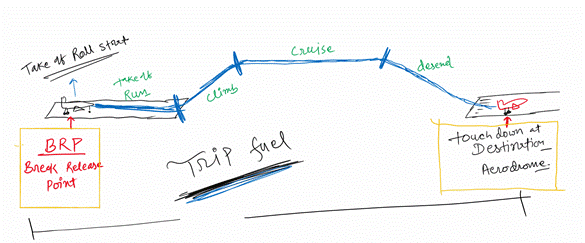
Trip fuel is the fuel required to operate the aircraft from brake release at the departure aerodrome to touchdown at the destination. It includes fuel for the entire flight profile—take-off, climb, cruise, descent, approach, and landing. This is the primary operational fuel component, calculated based on planned route, altitude, aircraft performance, and expected conditions. It does not include any reserve or contingency fuel, which are added separately for safety margins.
Trip Fuel (as per ICAO)
According to ICAO fuel planning requirements, Trip Fuel is the fuel required from take-off (brake release) to landing at the destination aerodrome under planned conditions.
Included in Trip Fuel:
- Take-off roll
- Climb to cruising level
- Cruise segment
- Descent
- Approach procedures
- Landing
👉 It represents the fuel to complete the planned flight profile only, without any allowances for abnormal or unforeseen conditions.
Trip Fuel (with Example)
Trip fuel is calculated based on fuel flow (fuel burn rate) and time spent in each phase of flight—climb, cruise, and descent. Each phase consumes fuel at a different rate, so total trip fuel is the sum of all phases.
Example 1:
Consider a flight with the following data:
- Climb: 10 minutes at 40 kg/min → 400 kg
- Cruise: 2 hours (120 min) at 25 kg/min → 3000 kg
- Descent: 15 minutes at 15 kg/min → 225 kg
Total Trip Fuel:
Trip Fuel = 400 + 3000 + 225 = 3625 kg
👉 In this case, 3625 kg is the fuel required from take-off to landing, excluding contingency and reserves.
Example 2:
A flight is planned with a fuel flow of 80 lb/hr. Allow 3 minutes for climb with an additional 6 lb, 2 hours 37 minutes cruise, and 10 minutes descent with no correction. Calculate the Trip Fuel.
Explanation:
Convert fuel flow: 80 lb/hr ≈ 1.33 lb/min.
Climb fuel = (3 × 1.33) + 6 ≈ 10 lb.
Cruise fuel = 157 × 1.33 ≈ 209 lb.
Descent fuel = 10 × 1.33 ≈ 13 lb.
Answer:
Total Trip Fuel = 10 + 209 + 13 = 232 lb (approx).