
Results
Q1. The Distance Measuring equipment (DME) uses the following wavelengths: (You should Know- DME frequency band: 962 MHz to 1213 MHz)~ comonly used 1000MHz
Decimetric Band Name Wavelength (m) Millimetric 0.001 – 0.009 m Centimetric 0.01 – 0.09 m Decimetric 0.1 – 0.9 m Metric 1 – 9 m Decametric 10 – 99 m Hectometric 100 – 999 m Kilometric 1,000 – 9999 m
Q2. To carry out a phase comparison between two electromagnetic waves:
both waves must have the same frequency
Q3. The plane of polarization of an electromagnetic wave is:
the plane of the electrical field The polarization of radio waves is defined as the plane of the electric field and is dependent on the plane of the aerial. A vertical aerial will emit radio waves with the electrical field in the vertical plane and hence produce a vertically polarized wave, and a horizontal aerial will produce a horizontally polarized wave. To receive maximum signal strength from an incoming radio wave it is essential the receiving aerial is in the same plane as the polarization of the wave, so a vertically polarized radio wave would require a vertical aerial.
Q4. Hertz (Hz) can be defined as:
the number of oscillations per second of an electromagnetic wave.
Q5. The definition of unit “Hertz” (Hz) is:
the number of oscillations per second of an electromagnetic wave.
Q6. The phase of the reference wave is 110Degree as the phase of the variable wave is 315Degree. What is the phase difference?
155Degree Phase difference = reference variable Here, Phase difference = 110-315-205 But we have to keep it positive so after adjusting 360 in -205 it will be 155 and it’s the correct answer.
Q7. What is the wavelength of a radio signal with a frequency of 375 kHz?
800 meters
Q8. If the wavelength of a radio wave is 3.75 meters, the frequency is:
80 MHz Formula f=C/lambda Where, lambda (Lambda) = Wavelength in meters c= Speed of Light (299,792,458 m/s) f= Frequency (MHz)
Q9. What is the frequency corresponding to a wavelength of 12 centimeters is?
2500 MHz
Q10. Unit of “Hertz” (Hz) is:
the number of oscillations per second
Q11. A horizontally polarized electromagnetic wave:
Has the E field horizontal
Q12. In regard to radio what does the term frequency mean?
The number of complete waveform passing a point in one second
Q13. A transmission of RF energy at a wavelength of 18 meters is in which frequency band?
HF
Q14. A radio signal has a frequency of 3 GHz, what is its wavelength?
10 centimeters
Q15. Into what range does ILS localizer wavelength fall? (You should know – ILS localizer frequency band: 108 MHz to 112 MHz)
Metric
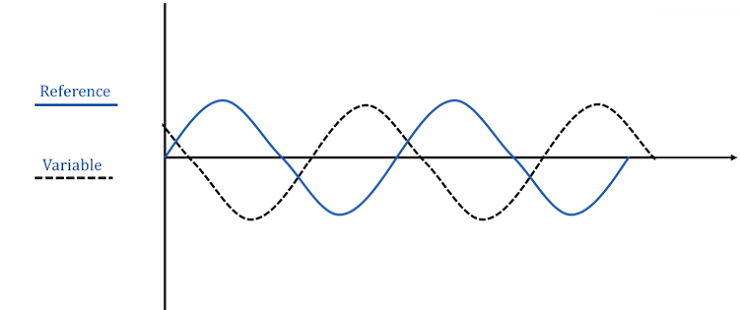
Q16. Find the phase difference between reference and variable wave ?
225
Q17. Wavelength is the distance from?
Wave crest to wave crest Wave crest to wave crest is correct answer Wavelength is distance from Crest to crest; trough to trough. Or distance travelled by wave in one cycle.
Q18. The speed of radio waves is:
300 million metres per second Light traveling through a vacuum moves at exactly 299,792,458 meters (983,571,056 feet) per second. That’s about 186,282 miles per second a universal constant known in equations and in shorthand as “c,” or the speed of light.
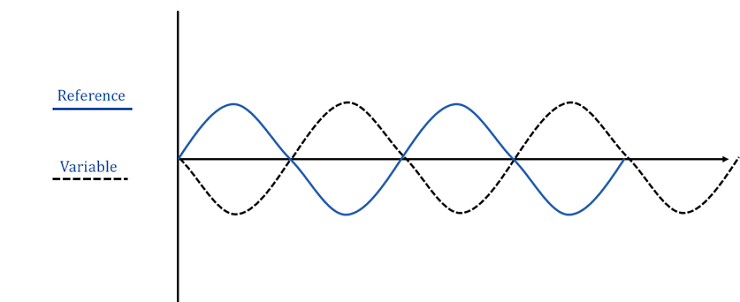
Q19. Find the phase difference between reference and variable wave ? ? 01NRM01
180
Q20. Assuming a wavelength of 1 centimeter, the frequency will be?
30 GHz
Q21. The phase of the reference wave is 140 degree as the phase of the variable wave is 315Degree. Find the phase difference between reference and variable wave ?
185
Q22. VLF (Very Low Frequency) waves appear in the frequency spectrum:
3 kHz-30 KHz
Q23. The phase of the reference wave is 240Degree as the phase of the variable wave is 045Degree. Find the phase difference between reference and variable wave ?
195
Q24. The phase of the reference wave is 020Degree as the phase of the variable wave is 300Degree. Find the phase difference between reference and variable wave ?
80 (or 080)
Q25. The Low Altitude Radio Altimeter (RADALT) uses the following wavelengths? (You must know – RADALT frewuency: 4200 MHz to 4400 MHz )
Centimetric Band Name Wavelength (m) Millimetric 0.001 – 0.009 m Centimetric 0.01 – 0.09 m Decimetric 0.1 – 0.9 m Metric 1 – 9 m Decametric 10 – 99 m Hectometric 100 – 999 m Kilometric 1,000 – 9999 m
Q26. The phase of the variable wave is 220Degree as the phase of the reference wave is 020Degree. Find the phase difference between reference and variable wave ?
160
Q27. In regard to radio what does the term frequency mean?
The number of complete waveforms passing a point in one second Definition of Frequency The number of wave cycles passing a point per unit time. Stated another way, it is the number of oscillations per second in the wave. A higher frequency means a shorter wavelength, and a shorter wavelength means a higher frequency. This leads us to the relationship between wave speed, frequency, and wavelength.
Q28. The frequency which corresponds to a wavelength of 6.98 cm is:
4.298 GHz
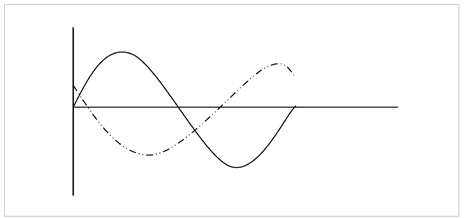
Q29. Find phase difference ? NRX010
225Degree Formula is Phase difference = reference – variable For calculating the phase difference look at the phase of difference and variable at any time.
Q30. The Secondary Surveillance Radar (SSR) uses the following wavelengths? (You should know – SSR frequency band: 1030 MHz to 1090 MHz)
Decimetric Band Name Wavelength (m) Millimetric 0.0010.009 m Centimetric 0.01 0.09 m Decimetric 0.1-0.9 m Metric 1 9 m Decametric 10-99 m Hectometric 100-999 m Kilometric 1,000-9999 m
Q31. A radio wave is:
an energy wave where there is an electrical field perpendicular to a magnetic field
Q32. The Automatic Direction Finder (ADF) uses the following wavelength? (You should know – ADF frequency band: 190 kHz to 1750 kHz)
Hectometric or Kilometric