
Fuel & Load Calculation
Students need to have a basic knowledge & understanding of the fuel load definitions before they attempt traffic load calculations.
Fuel Definitions
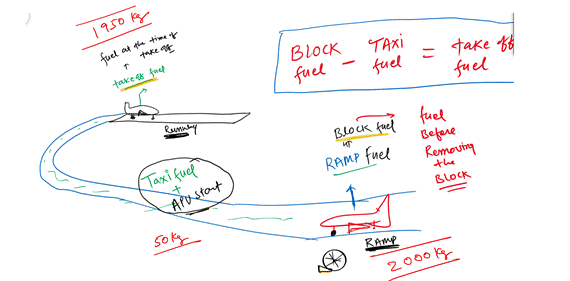
Bulk Fuel / Total Fuel on Board / Fuel at Ramp
Required Fuel to conduct the planned flight PLUS ‘Safety’ Fuel – required if the flight doesn’t go as planned.
Block fuel is the total fuel required for the flight and is the sum of the Taxi fuel, Trip fuel, Contingency fuel, Alternate fuel, Final Reserve fuel, Additional fuel, and Extra fuel.
Start and Taxi Fuel:
Taxi fuel is the fuel used prior to take-off and must include pre-start APU consumption, engine start and taxing.
Take off Fuel.
The take-off fuel for calculations is simply the sum of the above, excluding the start and taxi fuel.
Note that the fuel state requirements vary with the intended flight plan, and they are not always required.
Trip Fuel:
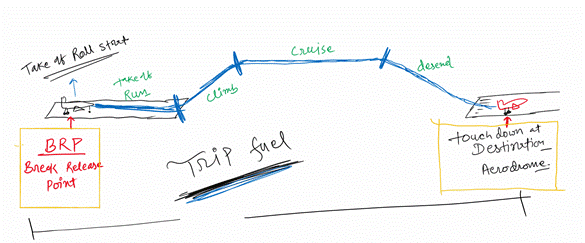
The Trip fuel is the required fuel quantity from brake release on take-off at the departure aerodrome to the landing touchdown at the destination aerodrome.
This is the mass of fuel required to complete the take-off run, the climb, the cruise, the descent, the expected arrival procedures, and the approach and landing at the designated airport.
Trip Fuel Calculation (Example)
Trip fuel is calculated based on fuel flow and time for each phase of flight, with any additional allowances added where specified.
Example Question:
A flight is planned with a fuel flow of 80 lb/hr. Allow 3 minutes for climb with an additional 6 lb, 2 hours 37 minutes cruise, and 10 minutes descent with no correction. Calculate the Trip Fuel.
Explanation:
Convert fuel flow: 80 lb/hr ≈ 1.33 lb/min.
Climb fuel = (3 × 1.33) + 6 ≈ 10 lb.
Cruise fuel = 157 × 1.33 ≈ 209 lb.
Descent fuel = 10 × 1.33 ≈ 13 lb.
Answer:
Total Trip Fuel = 10 + 209 + 13 = 232 lb (approx).
Contingency Fuel:
Fuel carried in addition to the trip fuel for unforeseen eventualities such as avoiding bad weather or having an extended hold duration at the destination airport.
The contingency fuel in calculations is usually given as a percentage of the trip fuel.
e.g.
- if the trip fuel is 1000 kg mass the contingency fuel at 5% of the trip fuel (minimum) would be 50 kg. Do not forget that the contingency fuel is part of the landing mass if it is not actually used during the trip.

Alternate (Diversion) Fuel:
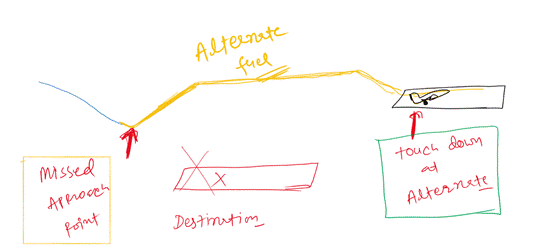
Alternate fuel is the amount of fuel required from the missed approach point at the destination aerodrome until landing at the alternate aerodrome.
That mass of fuel required to carry out a missed approach at the destination airfield, and the subsequent climb out, transit to, expected arrival procedures, approach, descent and landing at an alternate airfield.
Final Reserve Fuel / Fixed Reserve Fuel / Holding Fuel
Final reserve fuel is the minimum fuel required to fly piston engine aircraft for a further 45 minutes or a jet engine aeroplane to fly for a further 30 minutes at 1,500 feet above the alternate aerodrome or, if an alternate is not required, at the destination aerodrome at holding speed in ISA conditions.
If the flight is planned without alternate, the final reserve fuel should be no less than 60 minutes holding fuel.
Additional Fuel
Additional fuel is fuel which is added to comply with a specific regulatory or company requirement.
Examples include fuel for technical deficiencies such as engine failure or loss of pressurization, ETOPS fuel, fuel required for a remote or island destination where no alternative is available.
Extra Fuel
Extra fuel is fuel added at the discretion of the Commander. The Commander must consider the viability of the planned route and alternates and consider whether any statistical contingency is valid to the conditions on the day.
Landing fuel
The landing fuel mass is the actual amount of fuel remaining in the tanks at touchdown.
In a trip where no eventualities have occurred then landing fuel will include the contingency, alternate, final reserve, and additional fuel masses if they were included in the flight plan.
Load Definitions
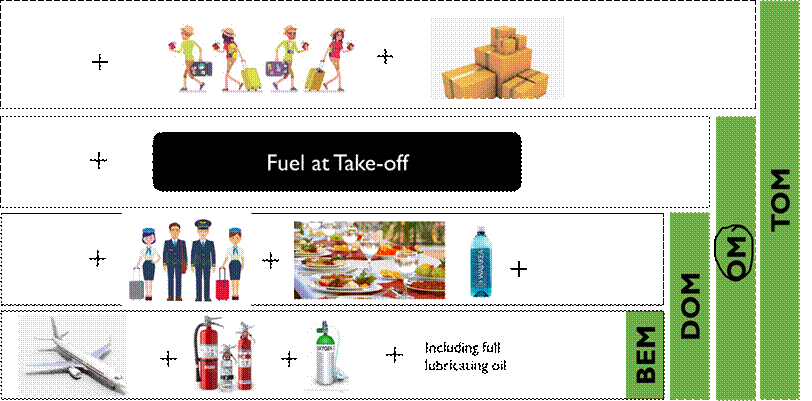
Empty Mass
When an aircraft is purchased by an airline / operator, it arrives empty and ‘uncluttered’ with several items that the airline would like to permanently carry for the rest of its life with that airline. The aircraft may have been weighed prior to delivery and the resultant mass is called the Empty Mass. The Empty Mass is not defined in CAP 696 because it is rarely (if ever) used.
Includes undrainable oil (essential oil).
Basic Empty Mass (Basic Mass)
When the aircraft arrives at the operating base of the airline, the operator will require certain items to put aboard in order to meet certain safety regulations and allow the flight crew and cabin crew to function. These items will increase the mass of the aircraft to its Basic Mass or Basic Empty Mass.
The Basic Empty Mass or Basic Mass is the mass of an aeroplane including standard items required by and provided by the aircraft operator such as: –
· Operations manuals, airfield charts and other ‘library’ documentation
· Unusable fuel and other unusable fluids
· Lubricating oil in engine and auxiliary units
· Fire extinguishers
· Pyrotechnics
· Emergency oxygen equipment
· Supplementary electronic equipment
· Plus, anything else the operator wants installed permanently aboard the aircraft.
Dry Operating Mass (DOM)
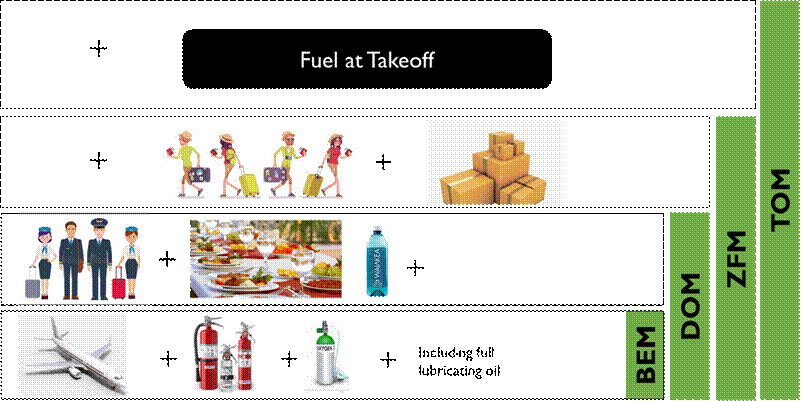
Dry Operating Mass (DOM) is the total mass of the aeroplane ready for a specific type of operation excluding usable fuel and traffic load. The mass includes items such as:
I. Crew and crew baggage.
II. Catering and removable passenger service equipment.
III. Potable water and lavatory chemicals.
IV. Food and beverages.
Traffic Load / Payload
Traffic Load is the total mass of passengers, baggage, and cargo, including any ’non-revenue’ load.
Useful Load
Useful Load is the total mass of the passengers, baggage, and cargo, including any non-revenue load and usable fuel. It is the difference between the Dry Operating Mass and the Take-Off Mass.
Useful load =Traffic load + Take off fuel.
Operating Mass (OM)
Operating Mass is the DOM plus fuel but without traffic load.
Zero Fuel Mass (ZFM)
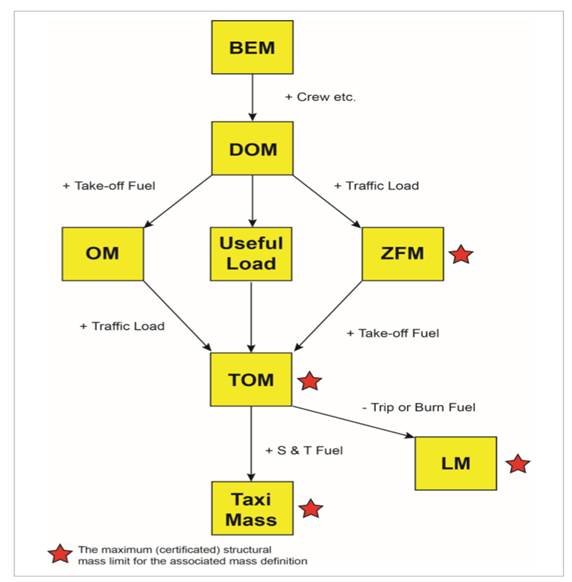
Zero Fuel Mass (ZFM) is DOM plus traffic load but excluding fuel.
Maximum Zero Fuel Mass (MZFM)
Maximum Zero Fuel Mass is the maximum permissible mass of an aeroplane with no usable fuel.
The maximum zero fuel mass is a mass limitation for the strength of the wing root.
Take-Off Mass (TOM)
Take-Off Mass is the mass of the aeroplane including everything and everyone contained within it at the start of the take-off run.
Maximum Structural Take-Off Mass (MSTOM)
Maximum Structural Take-Off Mass (MSTOM) the maximum permissible total aeroplane mass at the start of the take-off run.
Performance Limited Take-Off Mass (PLTOM)
Performance Limited Take-Off Mass is the take-off mass subject to departure aerodrome limitations.
Regulated Take-Off Mass (RTOM)
Regulated Take-Off Mass is the lowest of the ’performance limited’ TOM and ’structural limited’ TOM.
Maximum Structural Taxi Mass/Ramp Mass / Block Mass
Taxi Mass is the mass of the aeroplane at the start of the taxi (at departure from the loading gate). Sometimes referred to as Ramp Mass.
Ramp mass – Taxi fuel = Take-off Mass
Maximum Structural Taxi Mass
Structural limitation of the mass of the aeroplane at commencement of taxi.
Landing Mass
The Landing Mass is defined as the Take-Off Mass MINUS the fuel used on the journey, called the Trip Fuel.
The Maximum Landing Mass of an aeroplane is restricted by structural limitations, performance limitations and the strength of the runway.
Maximum Structural Landing Mass (MSLM)
The maximum permissible total aeroplane mass on landing in normal circumstances.
If the maximum structural landing mass is exceeded the undercarriage could collapse on landing.
Performance Limited Landing Mass (PLLM)
Performance Limited Landing Mass is the mass subject to the landing aerodrome limitations.
Regulated Landing Mass (RLM)
Regulated Landing Mass is the lowest of the ’performance limited’ landing mass and ’structural limited’ landing mass.
Payload Calculation
1ST Step: Find allowed Take off mass
- TOM = Ramp mass – Taxi FUEL
- TOM = Landing Mass + Trip fuel
- TOM = ZFM + Take-off fuel
TOM= DOM + Traffic + Take-off Fuel
2nd Step: Payload Calculation
Payload = TOM – ( DOM + Fuel at Take-off )
3rd Step : Useful Mass
Useful Load = Payload + Fuel at take-off
Important point:
- The maximum taxi (ramp) mass is governed by structural considerations.
- The maximum zero fuel mass is a mass limitation for the strength of the wing root.
- An aircraft is ALWAYS limited by THREE masses: –
- Regulated Take-Off Mass (the lower of structural / performance limiting mass)
- Regulated Landing Mass (the lower of structural / performance limiting mass)
- Maximum Zero Fuel Mass (structural limiting mass)
- Standard weight:
- flight crew 85 kg., cabin crew 75 kg. each. These are inclusive of a hand baggage allowance.
- The standard mass for a child is 35 kg for all flights if occupies sheet.
- In mass and balance calculations the ” index” = the moment divided by a constant.
- The aircraft basic mass and CG position is found in the weighing schedule in the Aircraft Flight Manual and is adjusted to take account of any mass changes.
- An aeroplane may be weighed in an enclosed, non-air conditioned, hangar.
- An aeroplane is weighed prior to entry into service. The Operator is responsible for deriving the Dry Operational Mass from the weighed mass by the addition of the ‘operational items’.
- An aeroplane must be re-weighed at certain intervals. Where an operator uses ‘fleet masses’ and provided that changes have been correctly documented, at 9 years interval for each aeroplane.
- The operator also responsible for determination of the mass of ‘operating items’ and ‘crew members’ included within the Dry Operating Mass the commander.
Weighing of aircraft
To measure the mass and CG-position of an aircraft, it should be weighed with a minimum of 3 points of support.
Weighing procedure
- The weighing must be accomplished either by the manufacturer or by an approved maintenance organisation.
- Normal precautions must be taken consistent with good practices such as:
- checking for completeness of the aeroplane and equipment.
- determining that fluids are properly accounted for.
- ensuring that the aeroplane is clean; and
- ensuring that weighing is accomplished in an enclosed building.
- Any equipment used for weighing must be properly calibrated, zeroed, and used in accordance with the manufacturer’s instructions. Each scale must be calibrated either by the manufacturer, by a civil department of weights and measures or by an appropriately authorised organisation within two years or within a time period defined by the manufacturer of the weighing equipment, whichever is less. The equipment must enable the mass of the aeroplane to be established accurately.
What if Overload
↗ Larger angle of attack required at a given airspeed.
↗ Stall speed is increased.
↗ Take-off and landing runs have increased.
↗ Reduced rate of climb and reduced climb gradient.
↗ Reduced altitude capability and therefore potentially reduced terrain clearance.
↗ Increased fuel consumption and reduced range.
↗ Possibility of overstressing the airframe.